badge icon

Service Supply Suite

Child Care Service Supply Suite

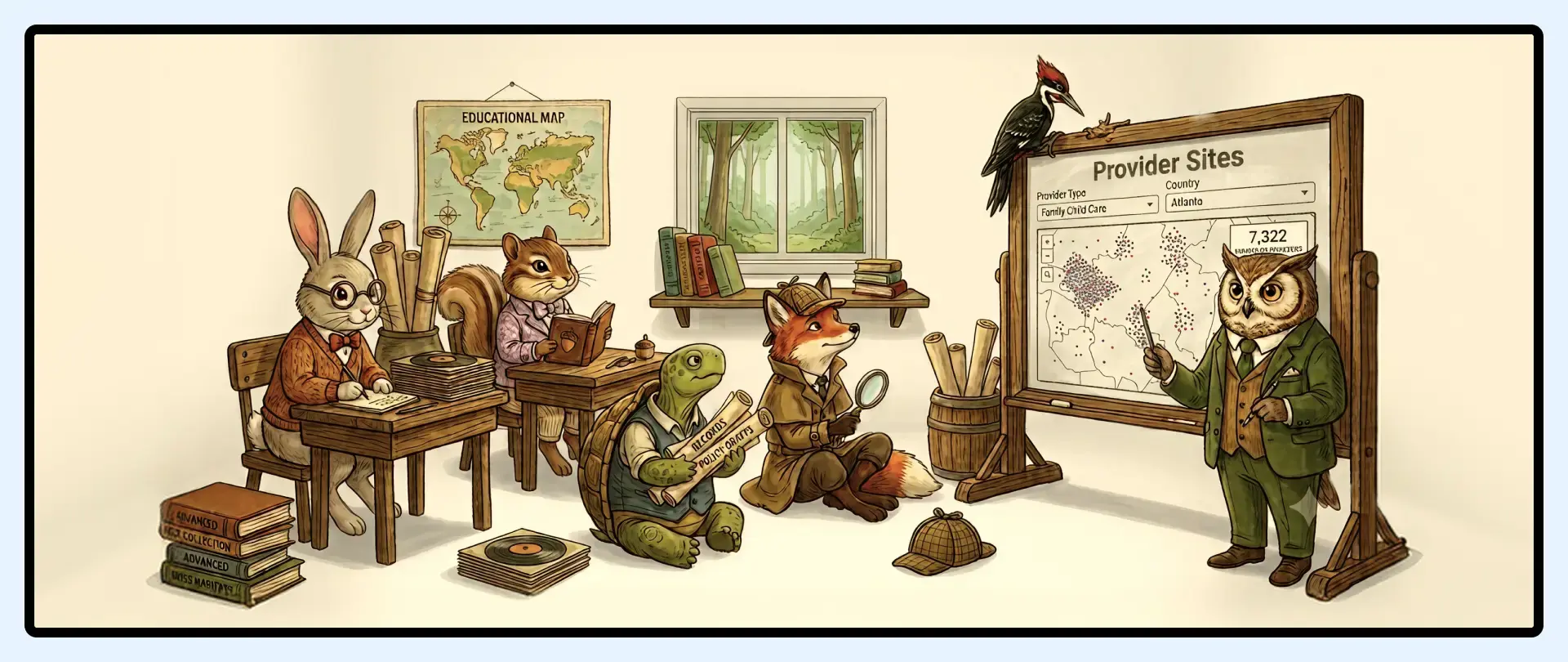
Understand the health, capacity, and stability of your child care provider network. The Service Supply Suite helps agencies monitor and strengthen the supply of child care across communities.

By bringing together licensing, workforce, subsidy, and program data, agencies gain a comprehensive view of provider capacity, provider stability, and network performance over time.

Agencies can identify emerging shortages and target investments where they will have the greatest impact. Whether addressing persistent gaps in rural communities or planning for growth in high-demand regions, leaders gain the insights needed to make proactive, data-driven decisions.
child-care-service-image

Key Capabilities

Stability

Provider Stability Analysis

Track when child care providers enter and exit the system to identify trends and take action before gaps become crises.

monitoring-icon

Capacity Monitoring

Track licensed capacity and available slots across provider types, age groups, and geographic regions to understand where additional investment may be needed.

cross-program-analytics

Cross-Program Analytics

Connect provider, workforce, licensing, and other program data to understand how factors like staffing shortages and credential gaps influence provider stability and capacity.

Part of the CUSP Foundation Ecosystem

The Service Gaps Suite and Service Supply Suite work together to provide a complete picture of the child care network.

  • star The Service Gaps Suite identifies where children and families need greater access to care.
  • star The Service Supply Suite evaluates whether the provider network has the capacity and stability to meet that need.

Built on the CUSP Foundation's integrated data model, both solutions give agencies a shared source of truth for planning, investment, and policy decisions.

CUSP Foundation Ecosystem

Core Modules 

  • blue-listing-icon Integrated Data Model
  • blue-listing-icon Research Starter Kit
  • blue-listing-icon Analytics Library
  • blue-listing-icon Atlas

Bundled Modules 

  • blue-listing-icon Service Gaps Suite
    • blue-listing-icon Access Desert Analytics
    • blue-listing-icon Child Care Gap Analytics
    • blue-listing-icon Community Analytics
  • blue-listing-icon Service Supply Suite
    • blue-listing-icon Provider Analytics
    • blue-listing-icon Child Care Fact Sheet (Community-level and Site-level)
    • blue-listing-icon Service/Program Integration

Real-World Impact

See how agencies use the Service Supply Suite to strengthen provider networks and
optimize system capacity.
tracking-attendtion-image

01

Tracking Attrition to Target Retention

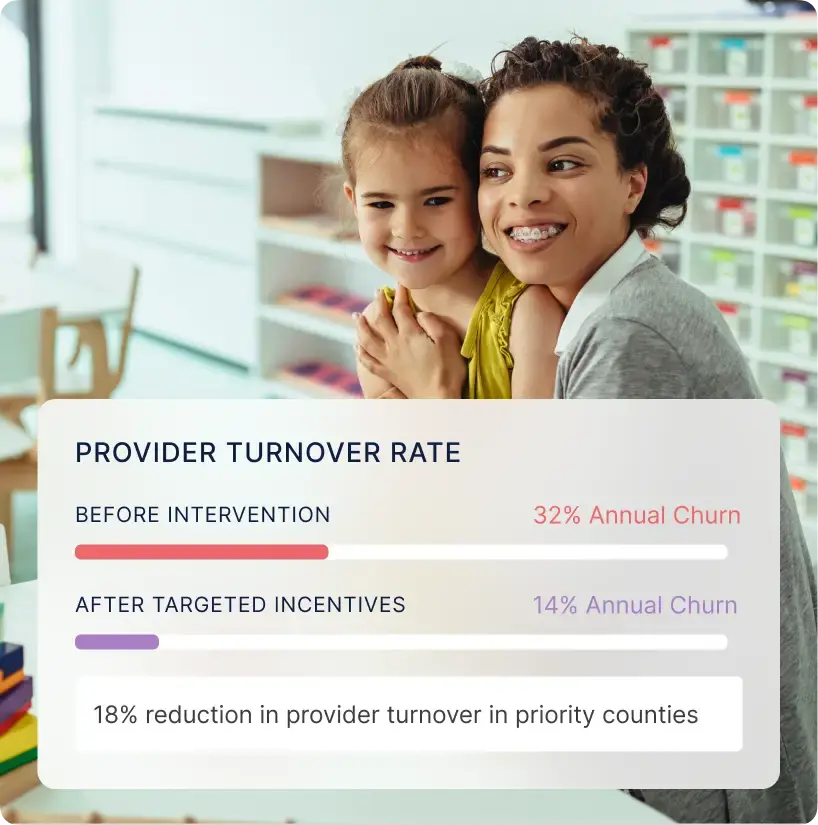
A state agency struggling with high provider turnover used the Service Supply Suite to better understand the factors driving attrition and identify providers at elevated risk of closure before they left the child care system.

These insights helped the state develop a targeted incentive program that reduced provider turnover by 18% in priority counties within one year.

By replacing anecdotal information with data-driven analytics, the state agency was able to take proactive action, strengthen provider stability, and improve long-term child care capacity.
forecasting-capacity-image

02

Forecasting Capacity Shortages to Maintain Access

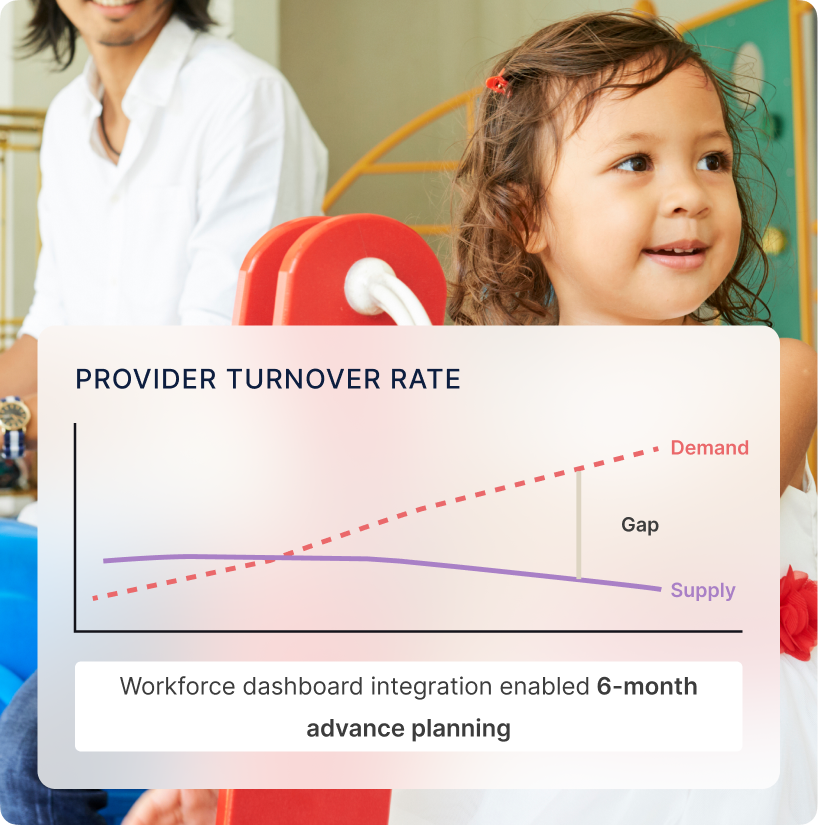
A state agency used the Service Supply Suite' to identify potential child care shortages before they impacted families and employers. The state agency was able to pinpoint markets at risk of losing capacity six months in advance. With early visibility into emerging child care shortages, the state was able to launch proactive and targeted recruitment efforts and accelerate credentialing, which helped prevent service disruptions and maintain access to child care.

This use case demonstrates the value of predictive child care supply analytics—helping agencies anticipate future capacity challenges and take action before families lose access.


Ready to reveal and address service
gaps in your state?

Connect with our team to learn how the Service Gaps Suite, the leading child care service gaps analytics suite for state agencies, can help you make targeted, equitable investments in early childhood services.

Frequently Asked Questions

What is the Service Supply Suite, and how does it help state agencies manage child care capacity?

The Service Supply Suite is a bundled analytics solution within the CUSP Foundation platform, designed to help state agencies monitor, analyze, and strengthen their early childhood provider networks. It functions as a full early learning capacity management platform, integrating licensing, subsidy, and workforce data into a unified view of system capacity. Agencies use it to track provider entry and exit, measure slot availability, identify access gaps, and forecast future shortfalls. By replacing fragmented spreadsheets and siloed data systems with connected child care service supply analytics, it gives administrators the visibility they need to make proactive, evidence-based decisions rather than reactive ones.

How does 3Si's platform track child care provider attrition and predict capacity shortages?

The Service Supply Suite's child care provider stability monitoring engine continuously analyzes provider entry and exit patterns across your licensed network, flagging providers and regions that show early signs of instability. This data is then combined with workforce certification timelines, subsidy participation trends, and historical closure rates to power child care capacity shortage forecasting models. The result is a predictive child care supply analytics capability that gives state teams up to six months of advance notice before a capacity gap materializes. This allows agencies to respond with targeted recruitment, retention incentives, or emergency credentialing pathways before families lose access to care.

What data sources does the Service Supply Suite integrate to monitor provider network health?

The Suite is built on CUSP's Integrated Data Model, which connects licensing records, subsidy enrollment, workforce certification data, and program participation histories into a single early childhood supply demand data platform. This makes it a true child care licensing workforce analytics solution, not just a database- it actively links data across systems to surface relationships that would otherwise be invisible. Agencies can also integrate COI 3.0, Social Vulnerability Index data, and census-level demographic information through the Community Analytics module. The result is a child care provider ecosystem analytics foundation that reflects the full complexity of your state's child care market, from urban cores to rural child care provider supply analytics challenges.

How do the Access Desert, Gap Analytics, and Community Analytics modules work together?

Each module addresses a different dimension of child care supply, but they are designed to work as an integrated system. The child care access desert analytics module maps geographic areas where supply is absent or insufficient, the child care gap analytics module reveals why disparities exist by analyzing demographic, income, and language barriers, and the Community Analytics module layers COI and SVI data to contextualize those findings within broader community vulnerability. Together, they enable a complete child care provider network optimization strategy- helping agencies understand not just where to invest, but how to prioritize across competing needs. This three-module architecture turns raw data into a coherent framework for child care data driven policy planning at scale.

How is the Service Supply Suite different from standard child care management software?

Standard child care management software is typically designed for providers- tracking enrollment, billing, and attendance at the program level. The Service Supply Suite operates at an entirely different scale: it is state child care service capacity software built for system-level analysis and planning. Rather than managing individual programs, it functions as a child care provider network analytics platform that tracks trends across hundreds or thousands of providers simultaneously. It combines demographic child care disparity analytics, early childhood market saturation analysis, child care program closure analytics, and child care slot availability tracking into a single platform- capabilities that no standard child care management tool offers. For state agencies responsible for ensuring equitable, stable access across an entire jurisdiction, it is purpose-built where generic tools fall short.