CUSP Overview
Building a World-Class Early Childhood Integrated Data System
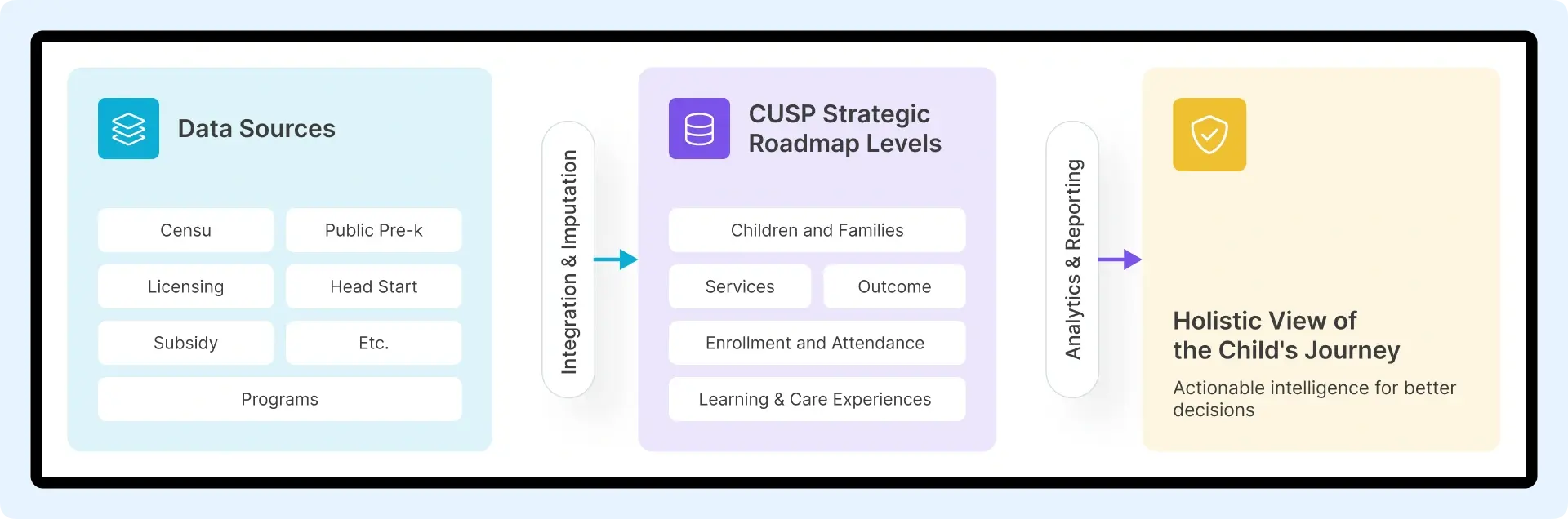
Scattered data systems make it impossible to fully understand your child population or to see where needs aren't being met. CUSP, the Child Universal Success Platform, integrates data from across programs into one trusted source, creating a complete picture of children, services, and providers.
This clarity helps government agencies identify unmet needs, allocate funding wisely, and measure the true impact of their work. As an early childhood integrated data system, CUSP gives state agencies the evidence base they need to optimize early childhood public policies and improve decision making at every level.
What is CUSP, and How Does It Support State Agencies?
CUSP is an industry-leading ECIDS early childhood platform that unites child, family, provider, and program data into one connected system. It gives agencies the evidence base needed to understand impact, design better programs, and improve equity in early learning and care.
As a cross-agency early childhood data platform, CUSP solves what most states struggle with most: early childhood data integration from disparate sources, Census, Public Pre-K, Head Start, Subsidy, Licensing, and more, all governed in one place. Whether you're looking to identify unserved children, track child population data from birth to five, or surface early childhood disparities and access identification data, CUSP makes it possible.
Unified Data Architecture
Connect and govern data from multiple sources in one secure platform, eliminating silos across early childhood government agencies
Population-Level Intelligence
Identify gaps and track improvement trends. With early childhood continuous quality improvement data and child care quality engagement real-time measurement, your team can move from reactive to proactive.
Child Care Longitudinal Data Tracking Over Time
Follow cohorts from birth through early grades to measure long-term outcomes and program performance enhancement
Early Childhood Public Policy Optimization
Arm policymakers with the right data at the right time to make evidence-based decisions on funding, access, and equity
Two Platforms. One Vision.
CUSP brings together foundational data integration and advanced analytics tostrengthen early childhood systems.
CUSP Foundation
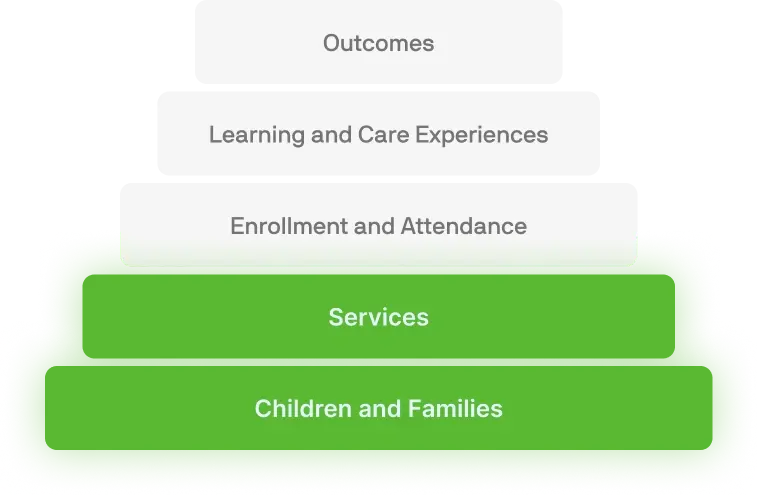
Unify child, provider, and program data to build your data foundation. CUSP Foundation is where early childhood data integration begins, pulling together disparate sources into a single, governed model that supports child care population data analysis for government agencies of all sizes.
CUSP Advanced
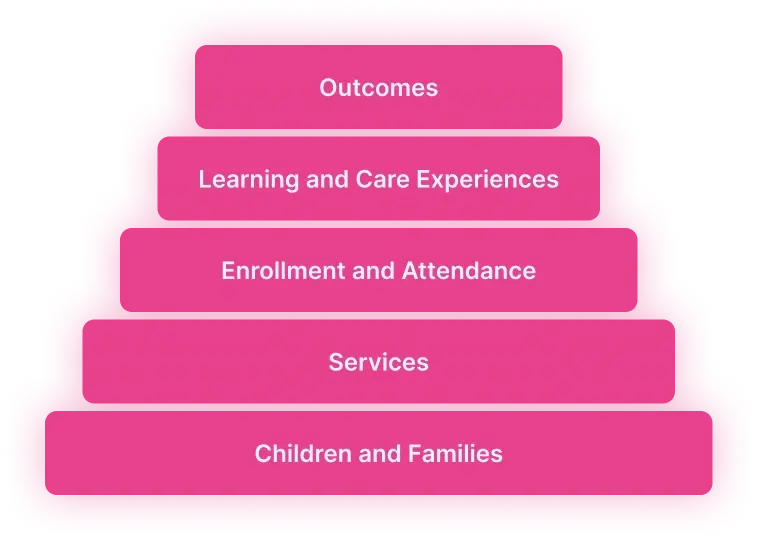
Add real-time analytics to monitor performance, compliance, and outcomes. CUSP Advanced extends the Foundation with an Event Analytics Suite designed for agencies that need to go deeper, tracking child care eligibility, enrollment, and outcomes data in real time, and enabling early childhood program performance enhancement across the system.
About the Platform
The Child Universal Success Platform (CUSP) enables state agencies to integrate, analyze, and act on early childhood and social-service data through modular analytics components. As a cloud platform that keeps states in control of their own data, CUSP is built for security, transparency, and long-term scalability.
CUSP is available in two packaged solutions: CUSP Foundation and CUSP Advanced. CUSP Advanced includes all Foundation modules plus additional analytics capabilities.
Note: CUSP Advanced is priced separately from CUSP Foundation.
CUSP Foundation: Core and Bundled Modules
Build your foundation with connected tools designed to reveal insights, identify gaps, and strengthen your system.
CUSP Integrated Data Model
A unified framework connecting child, family, and provider data is the backbone of your early childhood integrated data system.
Research Starter Kit (RSK)
Explore population, provider, and service landscape insights. Use the RSK to conduct child care population data analysis and quickly surface where gaps and disparities exist across your state.
CUSP Analytics Library
Access pre-built visualizations and dashboards designed to help state teams improve early childhood decision-making without needing a data science team on day one.
Service Gaps Suite
Identify where families lack access to care, a critical tool for agencies working to identify unserved children and address early childhood disparities in access.
-
Access Desert Analytics
-
Child Care Gap Analytics
-
Community Analytics
Service Supply Suite
Understand your provider landscape and support child care longitudinal data tracking over time to measure supply changes and outcomes at the community level.
-
Provider Analytics
-
Child Care Fact Sheet
-
Enhanced Program Integration
CUSP Advanced: Event Analytics Suite
From Insight to Impact. Monitor outcomes, manage risk, and improve performancein real time.
Risk & Audit Analytics
Smarter oversight through data-driven risk scoring, helping agencies flag concerns early and allocate audit resources where they're needed most.
Program Lifecycle Analytics
Track participant journeys from application to exit, supporting child care eligibility, enrollment, and outcomes monitoring, and enabling agencies to optimize early childhood public policy with longitudinal evidence.
Licensing Analytics
Strengthen licensing oversight and resource allocation through real-time data on provider compliance and capacity.
Frequently Asked Questions
The Child Universal Success Platform (CUSP) is a SaaS-based early childhood integrated data system built specifically for state agencies managing early childhood government data across multiple programs. CUSP works by connecting disparate data sources, including Census, Head Start, Subsidy, Licensing, and Public Pre-K, into a single governed data model. Once integrated, agencies can run analytics, identify service gaps, track child outcomes from birth to five, and generate the reporting needed to optimize early childhood public policies. It is purpose-built for the complexity of cross-agency early childhood data environments, where no single system has a complete picture of the child population.
This is the core CUSP Foundation vs. CUSP Advanced two-platform overview question most agencies ask. CUSP Foundation focuses on data integration and foundational analytics. It builds your data infrastructure and helps you understand population-level trends, provider supply, and service gaps. CUSP Advanced adds the Event Analytics Suite on top, enabling real-time monitoring of child care eligibility, enrollment, and program outcomes, as well as risk scoring and licensing oversight. Many states start with a foundation to build the data model and then layer Advanced as operational needs mature. CUSP Advanced is priced separately and includes everything in Foundation, plus additional capabilities.
CUSP is designed as a SaaS ECIDS for rapid implementation, deployable in under one year in most state environments. Pricing is modular and depends on which platform (Foundation or Advanced) and which bundled modules you select. Because CUSP is built on a shared Databricks cloud data platform, states avoid the multi-year custom build timelines typical of legacy ECIDS procurement. For states looking to augment or replace an existing ECIDS, CUSP can be scoped to meet you where you are. Contact the Team3si team at info@team3si.com for a tailored estimate based on your state's data environment and goals. x
Yes, and this is one of CUSP's most powerful differentiators. Using early childhood data, synthetic population modeling, and child care data imputation for unserved populations, CUSP can generate statistically grounded estimates of how many children in a geography are eligible for services but not currently enrolled. This child population data from birth to five, including those outside the administrative record system, is critical for agencies working to identify unserved children, close access gaps, and make the case for targeted investment. States like Massachusetts have used 3Si's early childhood data analytics approach to better understand where demand exceeds supply at the community level.
The CUSP vs. Salesforce early childhood data comparison comes up often, and the key distinction is purpose. Salesforce is a CRM designed for relationship management, not for integrating and analyzing population-level child and family data across government programs. Similarly, a State Longitudinal Education Data System (SLDS) is primarily focused on K-12 and doesn't have the birth-to-five infrastructure or the program-specific data models that early childhood agencies need. As for existing state ECIDS software, CUSP can either augment or replace an existing ECIDS, depending on your state's situation. Many states use CUSP to fill gaps that their legacy system cannot address, such as early childhood data integration from disparate sources, real-time analytics, or child care population analysis for government planning. CUSP is not a general-purpose platform retrofitted for early childhood; it is built from the ground up for this domain.